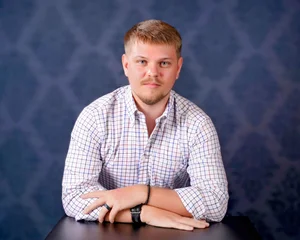
This is Russell. In December of 1998 he was a Senior Airman on an RC-135 Rivet Joint out of Prince Sultan Air Base, and his crew won the best reconnaissance aircrew award in the entire Air Force. Today he cannot raise his right arm to take an oath, can’t be handed anything sharper than a spoon, and relies on his son for nearly every aspect of life. He first asked the VA for a grant to get himself a wheelchair accessible ride in October of 2003. He is still asking. He has never gotten one, and he has never gotten the housing grant either. This Thanksgiving, his son will make the plate while we wait for the Christmas miracle in his appeal.

I want to tell you about Russell, and then I want to tell you about his son Jesse. I have been doing this a long time and I have never sat through a hearing like the one I sat through in July.
The Best in the Air Force
Russell enlisted in the Air Force in November of 1993. They sent him to the Defense Language Institute for two years of Arabic, then survival school, and made him a Mid-East cryptologic linguist. A local expert. His job was airborne reconnaissance. He flew on the RC-135 Rivet Joint, the aircraft that listens, finds what is shooting at you, and tells you before it does. A real life bad ass.
In mid-December 1998, Iraq blew off the UN resolutions and the order came down for air strikes. Operation Desert Fox. Russell’s crew got twelve hours of rest and launched on the night of December 17. Merry Christmas, brought to you courtesy of the red, white and blue.
His mission even made it into the base newspaper at Prince Sultan, and a copy of that article is sitting in Russell’s VA claims file to this day.
14 hours in the air that night. Mid-air refuel and keep fighting. More than 400 hours of combat support over the nights that followed. On December 30 they called a threat warning that let an RAF fighter pilot see the missiles coming and get out of the way, and then they supported the strike back against the site, which was the first time a Rivet Joint had ever done that.
For that, 4 of them won the Air Force Association’s General Jerome O’Malley Award, the best overall Air Force reconnaissance aircrew for 1998. You better believe Russell was one of the 4.
His DD-214 is the kind that runs out of room. Aerial Achievement Medal with three oak leaf clusters. Air Force Outstanding Unit Award with Valor Device, three oak leaf clusters. Combat Readiness Medal. Armed Forces Expeditionary Medal. Air Force Achievement Medal. Army Achievement Medal. Good Conduct times 3.
What It Cost Him
I asked Russell to write me something about himself. Here is what he sent, word for word, no polish or shine.
The 13 deployments are in his VA file, sure enough. Iraq, Kuwait, Saudi Arabia, Bahrain. The blasts are in there too. So is the rest of it. In June of 2000 they diagnosed compartment syndrome in both arms. In December of 2000 and again in March of 2001, surgeons opened both of his arms to cut the fascia and let the pressure out.
Reflex sympathetic dystrophy came in May of 2001. The medical board convened that August. By 2002 the Air Force had assigned him a care provider, while he was still on active duty. He was medically retired on March 17, 2003, at thirty-one years old.
Please raise your right hand
On July 22, 2026, after 23 years of this, Russell finally got in front of a Veterans Law Judge. You may wonder why the long wait? Well, as all too often, Russell got a decision from the VA. Lowballed rating. Shocker. He manages to get the appeal filed for all the issues. When VA went to address his appeal, guess what? The ink fell off the paper for about half his issues. They only issued a decision addressing half the issues he appealed. When he hired me, I quickly discovered the error and got the VA to open up the other part of his appeal which now dates back to 2003 because of it.
Anyhow, the Judge went to swear him in.
RUSSELL: I can’t raise my right.
JUDGE: No, no. Thank you. I appreciate that.
Six words. That is the whole case, and we haven’t even started yet.
The Boy Who Was Eight
The star witness wasn’t Russell. The witness was his son, Jesse, who has been his father’s full-time caregiver since 2021 and who was eight years old when his dad was injured during the explosion.
I asked Jesse what equipment he uses to move his father around the house. The transfer board, the lift, that sort of thing. He told me about the chairs and the grab bars, and the Hoyer lift they cannot fit in the house. Then he said this.
I asked about fine motor skills. Jesse explained that it is not that his father’s muscles are gone. It is that the nerve damage makes the arms fire off on their own, sudden, hard, uncontrolled. His dad has cuts on his face from his own hands. They keep his fingernails cut short, so he does not do more damage when it happens.
I asked about the kitchen.
He makes the meals. He cuts the food. He serves it. He counts the carbs, not because they are on Weight Watchers, but because Russell’s blood sugar sets off his seizures. No food if Jesse is not there. No medication if Jesse is not there. No getting from one room of the house to another if Jesse is not there.
Twice during that hearing Jesse had to stop and ask the Judge for a minute.
And in the middle of all that, he said something that I think really sums it all up.
Read Russell’s e-mail again. Thirteen tours, missing most of my oldest son’s formative years. The boy he missed is the man who Russell now depends on for everything.
Stayin’ strong anyway
Now let me tell you the part that keeps me smiling and is why I love this job, and why I am so thankful for men like Russell.

After he was retired out, Russell went back to school and kept going until he had a doctorate. He took up wheelchair fencing at Palo Alto College, made Team USA, and fenced for this country in World Cups and in the Zonals. Then he picked up wheelchair archery and won five more golds. By his count he is up to seventeen gold medals.
Check the picture closely. Look at how he is drawing that bow. He cannot reliably use his hands, so he releases the string with his mouth.


I have sat across from a lot of men who had every reason to quit. Give up. Turn into a vegetable. Here is how Russell put it to the Judge, when she asked him how all of this had affected him.
Tough bird if you ask me.
23 years of limbo
So, what has the VA done for him in all this time?
They did get to 100% in 2004, retroactive to the day he retired, and they granted aid and attendance back to that same day. I will give them that. Over the years the special monthly compensation has come up in pieces, and he is at the SMC(m) rate now.
Here is what they have not done.
- He first applied for a vehicle grant on October 10, 2003. Denied in 2004. He applied again in 2009. He applied again in 2020. Denied again in November of 2020.
- He first applied for specially adapted housing in 2010. And again in 2011. And 2012. And 2020. Denied every time, most recently in November of 2020.
- In 2005 the VA told him he did not qualify because he lacked “qualifying conditions such as loss of use of extremities, blindness, or loss of use of hands.” I invite you to go back and read Jesse’s testimony and tell me what you call it when a man can’t be trusted with a fork.
- In December of 2025 the VA denied service connection for loss of use of his left leg and his right arm. In the same breath, it proposed to cut his special monthly compensation from P-2 down to P-1.
- The best of all. VA denied his caregiver application, saying he didn’t need a caregiver and was fully independent, even though the VA had already granted aid and attendance.
23 years. He cannot walk. He cannot drive. He has not been able to get a grant to make his own house work, and the government that sent him out on those 13 summer camps has been arguing with him about whether he is really hurt.
Because his work was classified, Russell could never put the full story of how he got hurt into a claim form. He has spent two decades being told by people who have never heard of Desert Fox that he is exaggerating.
What He Actually Said
At the end of the hearing the Judge asked Russell directly how his disabilities had affected him. He had been mostly silent for an hour during the hearing. His son had been doing the talking because he could not.
This is what he said.
And then his son, sitting right next to him, said:
I have read that transcript a dozen times now. A man who gave his arms, his legs, his memory and his mouth to this country spent his one hour in front of a Judge apologizing to his family for it.
If that doesn’t give you something to be thankful for, something to say “I really don’t have it bad,” what will?
This Thanksgiving
Here is why I wanted to write this one before turkey day.
Thursday, most of us are going to sit down to a table we walked to on our own legs. We are going to pick up a knife and cut our own food. We are going to complain about the traffic, or the cousin who talks politics, or that the turkey came out dry. Then we will get up, carry our own plate to the sink, and drive ourselves home.
Russell will not and cannot do a single one of those things.
He will be wheeled to the table by the son whose childhood he spent in the air over Iraq. He will be handed a spoon, because anything else is dangerous. He will eat food that was cut up for him and portioned for his blood sugar so that he does not have a seizure at his own Thanksgiving dinner. And the government will not pay his son one dollar for any of it.
I don’t want to be doom and gloom on a day of thanks. I am telling you because I think gratitude is cheap when it costs nothing, and this year I want to highlight someone that had every reason to give up but could still muster up some thanks.
So, when you sit down Thursday, say grace for whatever you want. But somewhere in there, be thankful you can lift your own arm, and be thankful for the people like Russell who cannot, because the reason the rest of us get to is that men like him went and did the job.
I was in Washington, D.C. for Veterans Day this year. It was the first time I had ever been there for Veterans Day.
It was refreshing. Everywhere I turned, there were people out celebrating this Nation’s heroes, men like Russell, instead of finding one more reason to be divided. In the year this country turns 250, that meant more to me than I expected. I watched Americans just being Americans, coming together over the things we still have in common instead of arguing about the things we don’t.

I walked the memorials, and I thought about Russell the whole way.

The Wall is nothing but names, panel after panel of men who did the job and did not come home. Russell very nearly did not come home either. On his last deployment he died for about two and a half minutes. He is lucky to be alive, and he has never let what happened to him slow him down. A doctorate. Team USA. Archery. Still living life.

We are lucky for men like him. The folks on the Mall that day knew it. I hope we all remember it on Thursday.
Russell, I know you think you ruined their lives. You did not. You raised a son who sat under oath in front of a federal judge and told the United States government that he is the equipment for you. That is not a ruined life. That is the best thing a man can leave behind.
And Jesse, this country owes you a debt it has not even bothered to write down.
Happy Thanksgiving to both of you.
Happy Thanksgiving to all.
Godspeed.
Photos courtesy of Russell and his family.